
In “The Significance of the Frontier in American History,” Frederick Turner identifies the American frontier as “the meeting point between savagery and civilization” (1893). The frontier, according to Turner, made the West distinct from European influence by establishing a new American identity. Examining historiographies of the Western frontier reveal that definitions of the frontier continue to evolve and the impact of Turner’s frontier thesis on American Western history remains influential.
Turner identifies the frontier as distinctive from the Eastern region of United States based on environment, economy, social relations, and politics. Turner defines the West in a way the can be marked through boundaries and almost clearly defined. Additionally, Turner claims that the development of the West created “American” identity apart from European influence. This new American identity that formed through the Western frontier, relied heavily on individualism, forming knowledge about unknown Western lands and peoples, and masculinity identified with hard manual labor and independence.
The development of the West, according to Turner, also occurs in a linear process. He identifies three waves of settlers that inhabit the West. First, the pioneer who acquires what can be referred to as “free land” through agriculture and ranching. Second, are those who come to the West to purchase land and build the foundations of “civilized life” such as houses and schools. Lastly, the “men of capital” who come to the West to create towns and cities as well as the luxuries of civilized society.
As a result of Western expansion, the West influenced American economics and politics in unprecedented ways ranging from slavery to railroads to American democracy as a whole. The West, as described by Turner, appeared to be unregulated and self-governing and, therefore, apart from the Old World and European influence that offered new opportunities unbridled by the past.
Central to Turner’s thesis is the frontier as being at the edge of free land (1893). However, historians contest the idea that there is an “edge” to the frontier. In the Introduction to Contingent Maps, Susan Gray and Gayle Gullet state that “Place is socially constructed, and social construction is also our means of understanding place” (Gray and Gullet 2014, 11). When looking at Turner’s definition of the frontier, the intersection of “savagery” and “civilization” is not merely a “meeting point.” The social relations that occur at this meeting point contain a disproportionate power dynamic that is in favor of the settler. The settler is intent on “conquering” the West and acquiring the land employing the skills of his new masculinity. The social relations are less important than the acquisition of the land to the extent that the “savagery” the settler encounters is a barrier to obtaining the land.
For Turner, the frontier is a physical landscape and that landscape captures the peoples, cultures, environment, and other phenomena within it. However, a “place” can be thought of as a verb or as something that is performed by holding power over others both physically and mentally (Gray and Gullet 2014, 11). Therefore, “place” is informed by what we include and exclude within a particular space, blurs the boundaries of where the frontier begins and ends, and alludes to an understanding of the frontier as something that can, and still does, exist in how we understand American history more broadly.
“The existence of an area of free land, its continuous recession, and the advance of American settlement westward explain American development.”
Frederick Jackson Turner
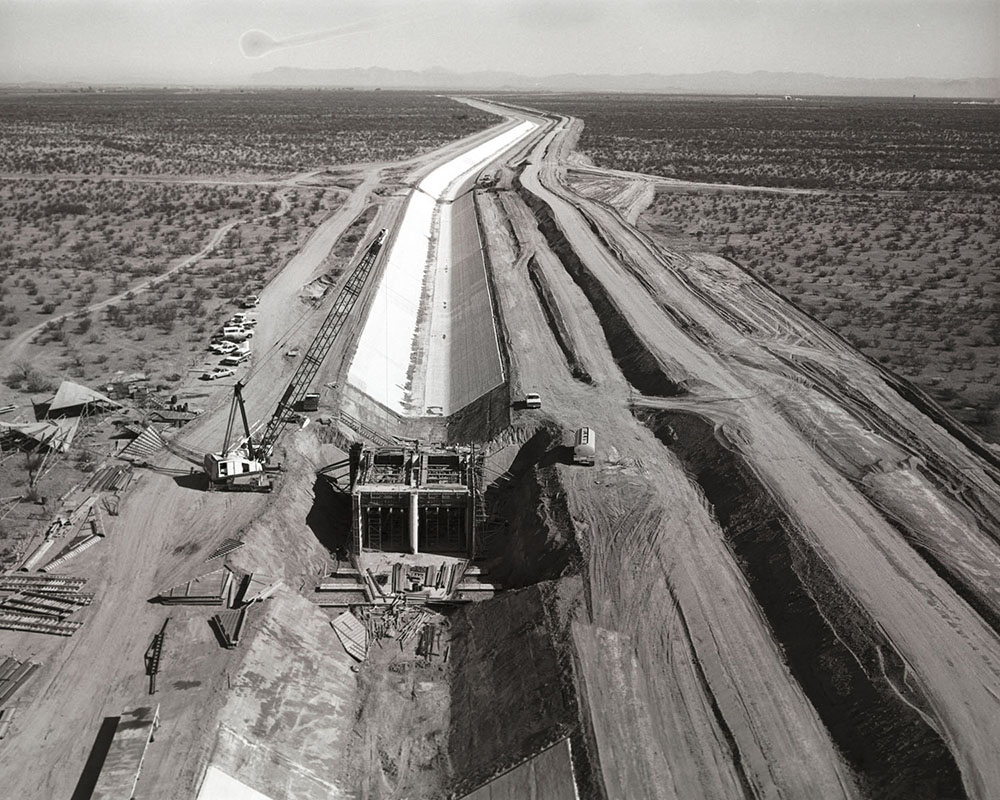
Header image: “Photo Gallery.” https://www.cap-az.com/public/photo-galleries.
 Central Arizona Project: Frontiers in Water Management